

How To Wire A 20 Year Old Night Vision Two Wire Camera
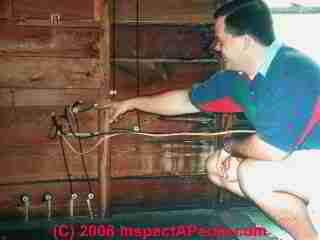 Onetime Electric Wiring Types, History of Electrical Wire Types
Photo guide to types of Electric Wiring in Older buildings
- Postal service a QUESTION or Annotate about former house wiring, knob & tube, old fuse panels, former business firm wiring condition & condom
InspectAPedia tolerates no conflicts of involvement. Nosotros have no human relationship with advertisers, products, or services discussed at this website.
History of electrical wire & electrical wiring: how to recognize knob and tube electrical wiring and unsafe "extension cord" wiring. How to evaluate the number of electrical circuits in an older home. Photo guide to types of old building electrical wires.
These photos help identify types, status, & hazards of old electrical wiring in buildings.
In this commodity serial, we list common old building electrical wiring system safety concerns and we illustrate types of erstwhile electrical wires and devices. This commodity series answers basic questions virtually assessing and repairing the electrical service, capacity, wiring type, condition, and safety in older homes.
We likewise provide an ARTICLE Alphabetize for this topic, or you can try the page top or bottom SEARCH BOX as a quick way to detect information you demand.
Photo Guide to Old Electrical Wire Types
... With the increase of electric lighting (which today is used only to a very express extent as compared with its inevitable future use) and the multiplication of wires, these dangers which exist now in a thousand different parts of the city volition be manifolded many times."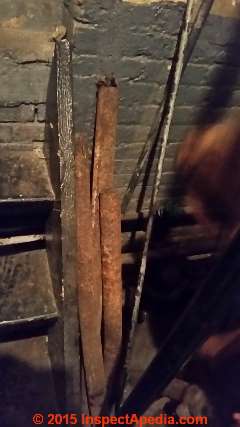 "So much has been said and written upon the bailiwick of high-tension electrical currents and their probable or possible danger to man life, and then many different opinions have been advanced by men whose positions serve to surroundings their utterances with an atmosphere of knowledge of the matter under discussion, that the mind of an unscientific public has been unable to come to any definite conclusion upon the ground of "skilful" testimony.
These rusty looking "pipes" may be the terminal remnants of the oldest and original electrical wiring used for hole-and-corner electrical power distribution in the U.South. We describe these electric power cables and provide images of and links to early electrical wiring and wire insulation methods in this article.
[Click to overstate any image]
In the electrical wire history & onetime wire identification commodity below, we illustrate a variety of types of electrical wiring institute in older buildings based on the wire insulation material (asbestos, cloth, plastic, metal) and the wire material itself: copper, aluminum, copper-clad aluminum, tinned copper.
While varying somewhat past expanse of the state in the U.S., Latin America, Europe, and other areas, in that location are recognizable generations of electric wiring.
Proper identification of the type of electric wire and wire insulation is useful for those seeking to guess at the historic period of a building or of its electrical system, and in some instances it is helpful in assessing the condition and safety of the edifice wiring system, such as taking note of the presence of branch circuit solid usher aluminum electric wire that has non been properly repaired - a fire take chances.
Hither are the types of former electrical wiring included in this article series:
- ALUMINUM Electric WIRE IDENTIFICATION
- ARMORED Cablevision or BX WIRE IDENTIFICATION
- ASBESTOS WIRE INSULATION IDENTIFICATION
- Cloth WIRE INSULATION IDENTIFICATION
- CONDUIT WIRE IDENTIFICATION
- COPPER CLAD ALUMINUM WIRE IDENTIFICATION
- EXTENSION, LAMP, ZIP CORD WIRE IDENTIFICATION
- FABRIC NMC WIRE INSULATION IDENTIFICATION - separate article
- KNOB & TUBE WIRE IDENTIFICATION
- PLASTIC NMC WIRE INSULATION IDENTIFICATION
- RUBBER WIRE INSULATION IDENTIFICATION
- SOLID PIPE EDISON DC Cable HISTORY - separate article
- THEATER WIRE IDENTIFICATION
- TINNED COPPER WIRE IDENTIFICATION
- WIRE LOOM or WIREDUCT WIRE CONDUIT
A 1980 US CPSC report found that crumbling electric systems are a cistron in the occurrence of electric fires in homes, an observation confirmed separately past Aronstein in explaining aluminum wiring hazards in what Aronstein calls the "bathtub curve" that maps failure rates over time.
Failures occur early in the wiring system life due to original installation defects and then failures occur again at an increased charge per unit tardily in the installation'southward life as the wiring ages and as it has been exposed to the vagaries of use over decades. This bathub curve of failure rates is illustrated
at ALUMINUM WIRING SAFETY ASSESSMENT.
Older homes ofttimes have electrical receptacles and fixtures that are ungrounded, and many local codes do non require that they exist rewired so they're grounded. Withal, grounding is worth adding to your system considering it adds protection against electrical shock.
But Dini points out that "... near of the hazardous atmospheric condition found in the 30 houses [studied] could be attributed to a lack of compliance with a specific code requirement". (Dini 2008).
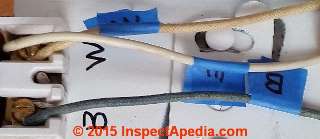
Above: two types of branch circuit electrical wire insulation are shown in our photo: braided fabric wire insulation, probably cotton fiber covered with wax or varnish, and newer plastic wire insulation.
The braided cloth wire insulation was found on a 1960's fluorescent low-cal ballast, while the plastic wire was used in the co-operative circuit wiring for the light where that anchor was employed. The quondam mode ballast and its wire could accept dated from the 1950's.
Aluminum Electrical Wiring Types
[Click to enlarge any image]
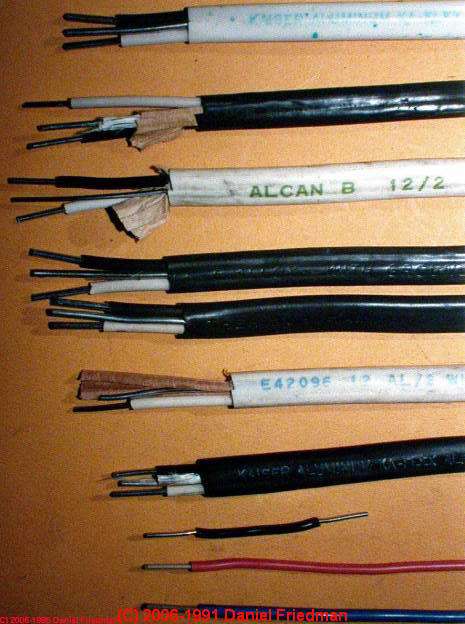
Equally you meet in the photo above, typically aluminum electrical branch circuit wiring was plastic-covered.
Aluminum wiring has been studied since about 1945, and began actualization in homes in North America as early on as 1965.
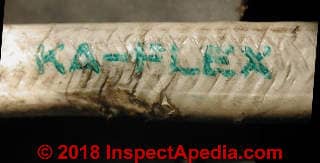
In that year Kaiser Aluminum and Chemical Corporation (KACC) began marketing KA-FLEX solid-conductor aluminum wiring (shown here).
Watch out: Unless information technology has been properly repaired or replaced, aluminum wiring in homes or other buildings is a serious burn hazard.
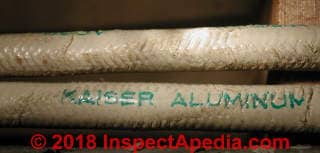
See complete details about aluminum electrical wiring
at ALUMINUM WIRING IDENTIFICATION
and at ALUMINUM WIRING GUIDE for Dwelling INSPECTORS for a discussion of safety hazards associated with aluminum wiring.
Watch out: improper "repair" of aluminum wiring using connectors that do non successfully prevent overheating (CO/ALR, CU-AL-stamped devices, and the Ideal No. 65 royal Twister), may increase the fire adventure in a abode and worse, may lead occupants to ignore danger signs of a possible burn down, thinking that their wiring is at present repaired and safe.
Copper Electrical Wire with Aluminum Sheathing under Plastic
Pulled this stuff out of a house. Couldn't get over how difficult it must have been to install. Aluminum sheath, cloth covered copper., 3 wire has loom and filler.
Thanks Sean we'll add that to the collection of wiring types - it'll help other readers - and I'll do some inquiry to encounter what background I can find.
Information technology would exist helpful to know the country and city of the abode where this was found every bit well as the age of the domicile and whether or not there are any special ecology concerns that might take led to the employ of this wiring.
Also we need to see the stripped dorsum wire ends to show other readers that this is copper wire in an aluminum sheath
I doubtable this was a grade of pre-wired "conduit" using semi-flexible aluminum tubing. I've included your photograph and farther comments and research in the article above on this folio.
Solid but flexible metal conduit (with rules about merely how it may be aptitude) is using solid aluminum and is i of several forms of pre-wired conduit that was probably intended for utilise in chancy areas.
I've on occasion seen such industrial products used in the construction of private homes, perhaps because the owner or architect had a line on some "free" materials that fell off of the truck. So to speak.
Armored Cablevision Electric Wiring "BX" & "Greenfield" - Metallic Sheathed Electrical Wire
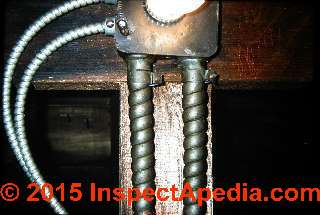
The photo higher up illustrates two generations of metal-sheathed armored cable or "BX" electrical wire.
The larger diameter wider-wrapped armored cable is probably Greenfield flexible steel armored cable, a wiring blazon patented in 1898.
Where does "BX" come up from? Dini (2006) explains that this cable was produced by Greenfield, one of its inventors, in two experimental forms AX and BX (X = experimental). The second version "B" was the more successful version that was produced.
The term "BX" stuck on later versions of flexible metal armored cable: the smaller-diameter modern "BX" wire is in the left of the photo and connects to the left side of the electrical box.
Also
see Electric WIRE STRIPPING TIPS where we discuss stripping and working with BX or armored cable.
Greenfield'south original blueprint used multiple strands of copper conductors, typically twisted, and surrounded by a pitch-like insulating fabric similar that nosotros illustrate in Edison'southward original clandestine electric cables shown
at STEAM BOILERS GENERATORS CONTROLS, PRATT.
Greenfield Cable Patented Flexible Conduit
Hither are the original image and a text excerpt from Edwin T. Greenfield'due south 1898 patent:
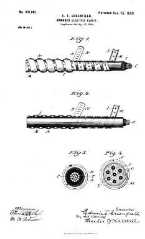
My invention is directed specially to improvements in electric cables designed for body of water service, and has for its objects,
first, to devise an armored cablevision of such nature that the insulation of the cable volition exist thoroughly protected from the attacks of borers or other insects or animals which usually assault cables of this nature when sunk in the body of the bounding main
second, to devise an armored cable of such a nature that its exterior armor will fully protect it (the cable) from unnatural article of clothing when it is suspended over ledges of rock in the body of the ocean;
third, to provide a cable of the nature indicated in which the armor is of steel, phosphor-bronze, or any preferred metal having the desired strength and qualities for adapting it for use in the ocean and in making such armor of a flexible nature, and so that the completed cablevision may exist wound upon a pulsate in the usual way when it is desired to lay it in the bed of the ocean, and,
4th, to provide a lead or equivalent covered cable with a flexible protecting armor which will protect the atomic number 82 covering from the action of metal slivers when drawn into a conduit.
Also run across a brother wiring material sold without conductors in this article:
CONDUIT WIRE IDENTIFICATION
Below: an early advertisement for Cres-Flex armored cable or "flexible metallic-sheathed" wire:
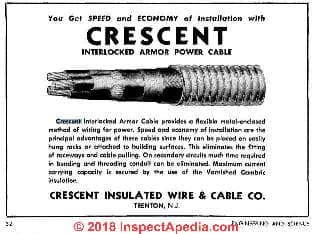
Crescent Insulated Wire & Cable Co. also fabricated material-insulated electrical wire described further
at FABRIC NMC WIRE INSULATION IDENTIFICATION.
Asbestos-Insulated Electrical Wiring
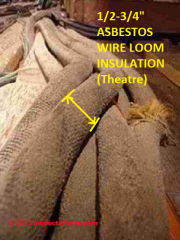
The asbestos-insulated electrical wiring wire loom or "flexible conduit" shown above is discussed in detail
at ASBESTOS Electric WIRE INSULATION.
Asbestos electrical wire insulation is reported by some websites equally "common" simply I suspect its apply was well-nigh mutual in applications where extra heat resistance and burn safety were a concern, such as theater wiring, electrical appliance wiring, aircraft wiring.
More examples of non-asbestos wire loom are given later in this commodity.
Textile & Varnished-Textile Insulated Electrical Wiring
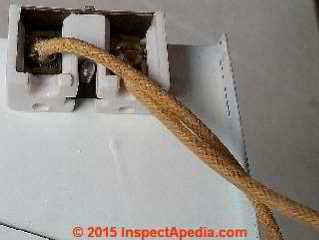
Higher up: varnished-cloth electrical wire on the anchor used in a fluorescent light fixture in a 1960'due south habitation built in northern Minnesota.
See complete details well-nigh material or fabric-covered electrical cable or wire
at Material NMC WIRE INSULATION IDENTIFICATION
Asbestos-impregnated type AVB fabric wiring insulation is discussed separately
at ASBESTOS Electrical WIRE INSULATION.
Conduit for Electrical Wiring
Metallic and more recently plastic tubing are both used equally conduit for routing and protecting electric wiring in a wide range of applications.
Dini (2006) notes that the earliest wire conduit textile (ca 1910) was made of woods moldings grooved to carry the conductors and covered with a wooden cap.
Simply you won't find that material today except perchance in an authentic or un-restored older building. Modernistic conduit is made of rigid metal that can be aptitude into elbows, plastic that includes pre-bent elbows, and flexible metal and plastic ENT materials.
Below you will notice big diameter plastic conduit bringing power to an electric sub console.
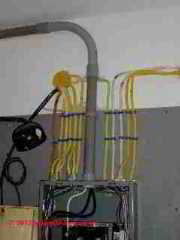
Electrical conduit is also sold in a flexible metal design that should not exist confused with BX or Greenfield armored cable: this flexible metal conduit looks similar BX or armored cable but is sold "empty".
Below this section of flexible metal conduit was a left-over scrap that had had three wires inserted through the protective cable.
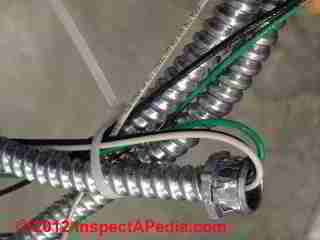
To compare flexible conduit with armored cablevision, BX, or Greenfield wiring,
see ARMORED Cable or BX WIRE IDENTIFICATION in this article.
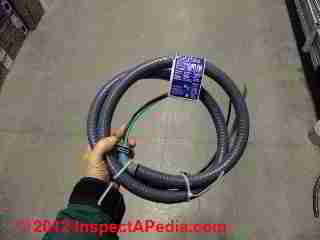
In nearly all new outdoor air conditioner & oestrus pump installations the electrician uses a pre-wired waterproof electric conduit whip (photograph above).
For details about metallic electrial conduit, please see our separate article
ELECTRICAL CONDUIT, Metallic where we depict merely about all of the types of modernistic electrical conduit materials including some not shown above.
Flexible Solid Aluminum Conduit Wiring
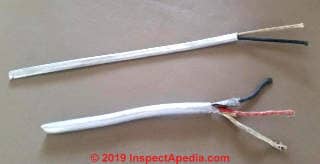
Above: metal clad cable using solid aluminum semi-flexible conduit pre-wired with material-insulated copper conductors, contributed by reader Sean 2019/08/11.
Sean wrote:
"Pulled this stuff out of a business firm. Couldn't get over how difficult it must have been to install. Aluminum sheath, cloth covered copper, 3 wire has loom and filler."
Excerpt from NFPA seventy-2005
In Class I & II, Partition two hazardous areas, the conduit itself cannot exist used every bit the grounding means. A bonding jumper must exist installed in accordance with NEC Section 250.102.
Flexible metal conduit is available with steel or aluminum armor in trade size v ⁄sixteen" to 4".
With few exceptions where 5 ⁄sixteen" and 3 ⁄8" trade sizes are used, Code prohibits utilize of conduit less than "d" trade size.
Bends in curtained work are restricted to 360 degrees full.
No angle connectors are permitted in concealed raceway installations.
Portions of this section reprinted by permission from NFPA 70-2005, National Electrical Lawmaking®, Copyright © 2004, National Fire Protection Association, Boston, MA.- retrieved 2019/08/xi, original source:
Metal CLAD Cable, ARMORED CABLE AND FLEXIBLE Metal CONDUIT [PDF] manufacturer'due south data sail from Farnell Electrical, http://www.farnell.com/datasheets/165782.pdf
Copper-Clad Aluminum Electrical Wiring
[Click to enlarge any image]
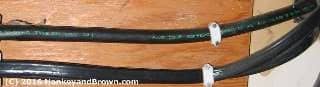
The photo of copper-clad aluminum electrical wire shows the wiring sheathing markings [click to enlarge]. This NMC or not-metal-sheathed cablevision electrical wire was observed in a 1974 Edina MN townhouse and was continued to an FPE electrical panel.
Unlike aluminum electrical wire used in branch circuits (a fire hazard), copper-clad aluminum wire performs about as well every bit copper wire and is considered safe for utilize in homes provided of course that the wiring has been correctly installed.
Photograph above provided by and used with permission of Roger Hankey, a Minnesota home inspector.
See details nearly copper-clad aluminum electrical wiring
at COPPER-CLAD ALUMINUM Electric WIRE
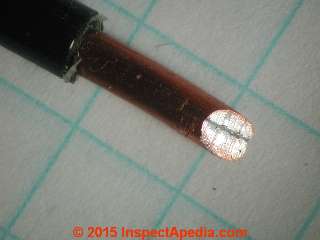
Extension Cord Electrical Wiring
At NUMBER of CIRCUITS in Former BUILDINGS,
we explain that the use of zip cord or extension cord mounted on or through walls and ceilings to add together lighting circuits or receptacles is improper, unsafe (a fire hazard), and is often an indication that the edifice does non have enough circuits for modern usage.
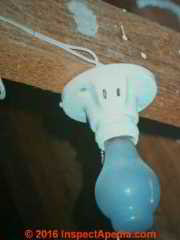
Spotter out: where we discover nothing cord electrical wiring it is important to see what other unsafe wiring practices that aforementioned installer may have followed.
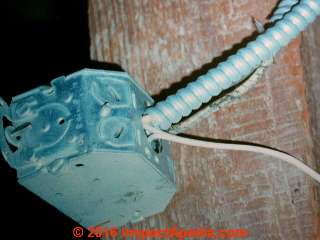
In a higher place the same do-it-yourself-er has left at least six, probably more dangerous details at this electrical receptacle:
- Missing strain relief on armored cable
- Extension string wiring used to extend the circuit
- Second circuit (beneath the armored cable) stripped back without connectedness to the electrical box at all
- Electrical box too small for number of conductors
- Electric box inadequately secured to the edifice
- No cover plate on the electric box.
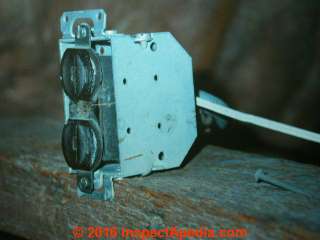
Below we bear witness the front end of this add-on electrical receptacle. One thing is "right" though: the installer used a two-prong receptacle that excludes a 3rd basis prong opening - every bit he should have done as the circuit does non include a grounding conductor.
Black, Greyness, Silver & White Colored Material Covered NMC Electrical Wire Insulation
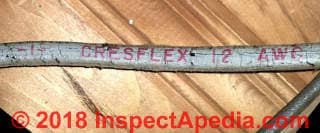 The exterior insulation on textile or fabric-insulated NMC electric wires are often black, argent, or white but may besides be black or brown.
The individual conductors within the cable may exist insulated in rubber or fabric-covered safety or they may be insulated by plastic in later wiring products.
See details including the history of manufacturers of cloth-insulated wire along with dates, trademarks, and identifying photographs of a number of these cloth-insulated wire types.
at Cloth NMC WIRE INSULATION IDENTIFICATION where nosotros besides discuss Paraflex & Paranite Insulated Electrical Wiring
As well see ASBESTOS ELECTRICAL WIRE INSULATION.
Knob & Tube Electrical Wiring
The earliest form of electrical wiring system in buildings in the U.Southward. was knob and tube: dissever hot and neutral wires were hung in air, spaced 2 1/2" or more apart, and insulated from contact with wood framing by ceramic knobs or where wire had to laissez passer through a wood framing member, ceramic tubes.
Both of these are shown in our photograph beneath. Knob and tube wiring macerated in popularity in Due north America past 1940, but continued to exist installed as new work in some locations (including New York) until about 1975.
This wiring every bit pre-existing or "old-work" electrical wiring, is notwithstanding described in the U.South. National Electrical Code (2005) in Article 394.
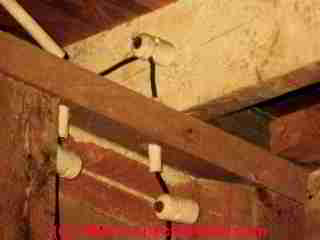
The knob and tube wiring shown above is discussed in item
at KNOB & TUBE WIRING - topic abode, where we discuss assessing the condition of knob and tube wiring and issues apropos improper extensions of knob and tube circuits.
Plastic or Nonmetallic Cable (NMC) Insulated Electrical Wiring: Romex Cablevision Wiring
Dini (2006) notes that NMC or plastic-insulated wire or "Romex" has been in use in the U.Due south. since near 1926.
Plastic NMC began replacing both rubber wire insulation and material-based wire insulation in the U.S. in the 1950'due south. PVC here refers to plastics based on polyvinyl chloride.
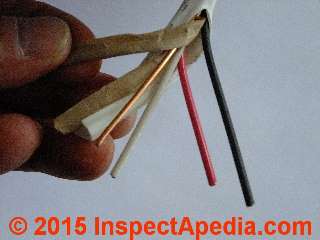
Plastic or thermoplastic nonmetallic cable such as that shown beneath, notwithstanding referred to by many electricians every bit "Romex" cable, has been in use since the 1960's and in the U.S. became very widely used in new residential construction by 1970, completely replacing fabric-based wire insulation products.
See FABRIC NMC WIRE INSULATION IDENTIFICATION.
Just in some jurisdictions including some large cities, local electrical codes require metallic armored cable
(ARMORED Cable or BX WIRE IDENTIFICATION) or electric conduit rather than plastic NMC.
Besides see ROMEX SPLICE CONNECTORS
Rubber-Insulated Electrical Wires
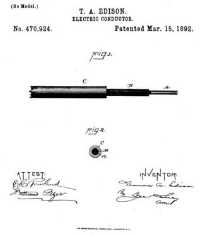
It's off-white to say that prophylactic in a somewhat unlike form was the first electrical wire insulating fabric, at least in the U.S., dating from Edison's 1892 patent from which we excerpt this part of Edison'southward wire insulation clarification:
The object of my invention is to effectively insulate wire, so that information technology volition be waterproof and capable of beingness used in moist places and fifty-fifty nether water without detriment to its insulating qualities, and also fire-proof, so that if by accident the wire becomes red-hot the insulating-covering will not be set on fire and burned, but merely oxidation will effect, which will exit the wire pyro-insulated.
The master feature of the invention is the use as an insulating-roofing of a mixture of condom with an infusible textile in the form of a powder.
Only actually earlier electrical ability cable and wiring insulation appeared every bit rope, tarred fabric, and even wood. Notwithstanding the safe insulated wire illustrated by Edison'due south 1892 patent represented the kickoff economic co-operative circuit usher wire insulation arroyo that could exist mechanically and economically produced in high book.
More electric generator equipment dating from Edison's twenty-four hours and even so on display at the Pratt Institute can be seen
at STEAM BOILERS GENERATORS CONTROLS, PRATT.
Mixed-Media wire: rubber-insulation over plastic-coated copper electrical wires
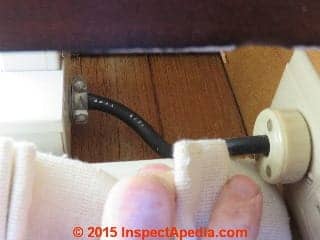
Above: This wire was a short department of extension string that had been used to connect a permanently-mounted fluorescent light fixture to power past plugging it into a wall-mounted electrical receptacle.
Below: this is a sample of plastic-insulated multi-strand electrical wire that was encased in the safe jacket shown in a higher place.
When the light failed to operate, the author, on disassembly, found that the insulation on this wire was desperately deteriorated, aging, and unsafe.
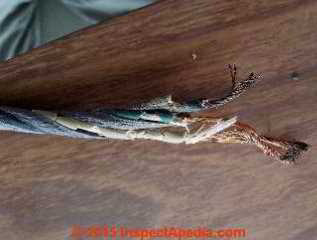
In our condom and cloth wire insulation photo beneath you lot can see that inside the outer condom wire jacket these conductors were insulated by fabric-covered rubber.
The color codes (white = neutral, blackness = hot) can be faded and difficult to recognize on these wires unless yous strip dorsum more than of the insulating jacket. The wire shown below combines the hot and neutral wires in an external rubber jacket. Simply the earliest electrical wiring systems in the U.Due south. used the knob and tube organisation.
See KNOB & TUBE WIRE IDENTIFICATION in this article or for details most knob and tube wiring
encounter KNOB & TUBE WIRING
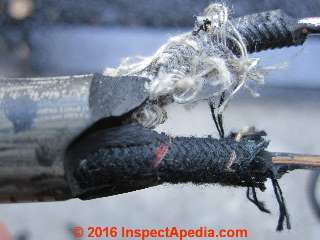
Sometimes you may find tinned-copper electrical wire in these older conductors. Don't fault tinned-copper for aluminum electrical wiring.
Ability Cable for Electric Welder
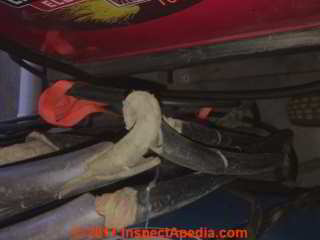
The damaged power cable shown above was used with a 1970'due south electric welder.
Beneath the heavy rubber outside of the welder ability cable nosotros see a cloth cloth that might be an asbestos fabric needed for extra estrus resistance.
Other readers familiar with this welder cablevision are invited to employ the folio elevation or bottom CONTACT link to offering more information.
Solid Iron Tubing or Steel Pipage & Pitch Insulated Electrical Cables
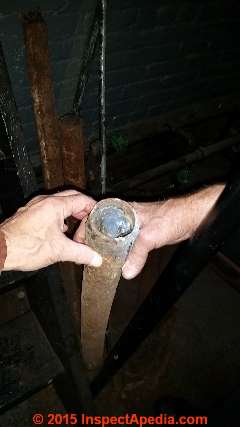
Higher up: Above nosotros're looking at the cutting-end of what is nigh likely a section of original DC or continuous current distribution cabling salvaged from a NYC trench.
The solid copper core is much thicker than my thumb
The solid copper cadre was wrapped in rope to insulate it from the iron pipage and the space between that cable and the surrounding iron pipe was filled with a pitch-like substance. - C.M.
Details are
at SOLID Piping EDISON DC CABLE HISTORY
Theater Electrical Wiring
In theaters where electric wiring is often temporary, we frequently find surprising and maybe unsafe installations. The safe-coated wires shown beneath were observed in a New York theatre and looked amend than what my brother-in-law Matt, a theatre electrician, could produce.
Theater fires are particularly dangerous as there is likely to be a crowd stampede to exits, poor lighting, and lots of combustible materials.
In my dwelling house boondocks, Richmond VA, the Hippodrome theater, opened in 1914, caught fire in 1945 when I was but two (then I'm non responsible). The burn was thought to accept been electrical in origin.
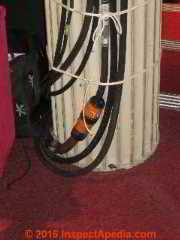
The U.Due south. NEC addresses theater wiring in several articles such every bit Commodity 530 - buildings or portions thereof used every bit studios using motion pic film or electronic tape more than 7/8" in width, Commodity 540 - wiring for movement motion picture projector rooms, and others.
See ELECTRICAL SAFETY in the THEATRE [PDF]
Tinned Copper Electric Wire
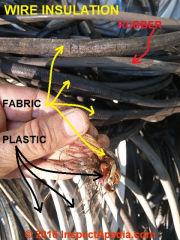
Above, we meet both older fabric-covered electric conductors and newer plastic-insulated wires in an electrical panel. The bare copper wire that is nearly black was a clue in tracking down a neutral and ground wiring failure at this building.
In a higher place, the aforementioned condom-insulated electrical wire discussed before is also used to illustrate the deadening silverish colored metal wire observed where tinned copper electrical wiring is installed.
Lookout out: tin can-plated copper wire is a completely different product that, because its conductors sport a thin plated silver colored surface, might exist mistaken for unsafe aluminum wire. Information technology is not aluminum and information technology is safe unless, as with any electrical wiring, it has been damaged in some manner.
Not all rubber insulated copper wire is plated, but if y'all doubtable that the silver-colored wire is plated copper, information technology'southward piece of cake plenty to determine: with the wire disconnected from whatsoever power source, scratch the argent colored surface of the rubber-insulated wire and yous'll run into its crimson copper interior.
In REDUCE THE AL WIRE RISK: DETAILS, also as in Aronstein (2011), Aronstein describes plated-copper wire as:
Plated copper wire [tinned copper wire] is relatively common in older homes, and it looks like aluminum wire. Information technology was commonly used with rubber-based insulation. Identification tin can be fabricated by careful inspection of a cutting cease of the wire.
In general, plated copper wire would not exist present in nonmetallic sheathed cable ("Romex"), it is nigh more often than not found in metallic sheathed cable ("BX"). Cable of the "BX" type is non likely to contain aluminum wire. - Aronstein (2011)
At TINNED COPPER ELECTRICAL WIRE nosotros provide additional give-and-take of how to avoid confusing tinned copper wire or tin-plated wire with aluminum wire such as the tinned copper multi-stranded wire shown below.
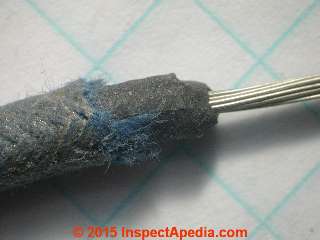
The heavy fabric braid wires shown in the left of this photo may exist mistaken for Wireduct, also referred to every bit All-Weather Loom - shown below. It is not. This is a material- and rubber-insulated multi-strand electrical wire.
Wireduct or Wire Loom flexible conduit
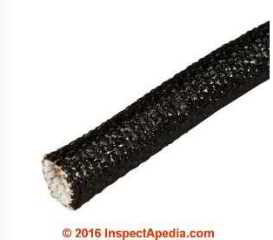
Wire loom or all-weather loom was sold as a non-metallic flexible conduit for protection of electrical wiring in buildings.
Wireduct all-weather loom wire insulation was produced in sizes from 1/4" to 2 1/ii" in bore and was described as having a flame-retardant stop and depression moisture absorption.
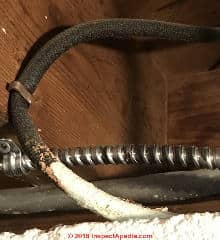
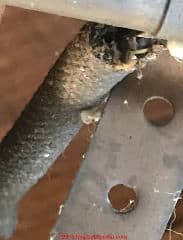
The two wire loom material conduit photos higher up were provided by InspectApedia.com reader Jared.
The asbestos "wireloom" shown earlier on this folio may be an example of this product likewise, designed for improved flame resistance in theaters. You may notice wireduct or wire loom on knob and tube electrical wiring systems as well every bit other older edifice electrical wiring.
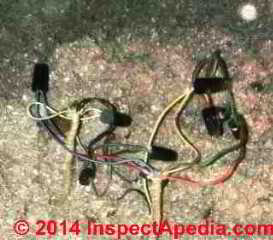
In the unfortunate electrical wiring situation shown above, a reader mailed us this photo of white (probably-asbestos) wire loom-wrapped electrical wires and splices left exposed in the floor of her attic. We caution that with this sort of electric work visible, i must worry about what other work was done on the edifice by the same installer.
Wire Loom is however sold every bit a cabling protection sleeve made in its electric current (2016) form as a colored nylon flexible slit corrugated tubing or as black polyethylene flexible tubing.
Equally we illustrate to a higher place in Jared's photos, cobblestone-impregnated cloth wire loom is too bachelor and is used in antique and original restoration work (photos adapted from EBay advertisements 2016/02/10). - Thanks to dwelling house inspectors Roger Hankey and Kevin O'Hornett for added details almost wire loom insulation, 2016/02/09
Below: a non-separate wire loom: Whittaker Fabric Wire Loom, iii/eight" bore.
This is an asphalt-impregnated cotton wire loom typically used in automotive applications. Some antique wire loom products or wiring sleeves are synthetic with a combination of cobblestone-impregnated cotton/poly paper alloy coated with asphalt for moisture resistance.
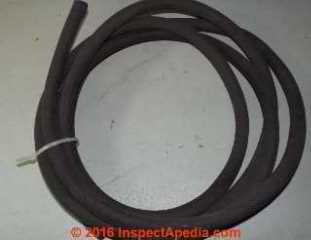
Special thanks to Minnesota home inspector Roger Hankey for assistance with material for this commodity. Roger Hankey is main of Hankey and Brown domicile inspectors, Eden Prairie, MN. Mr. Hankey is a past chairman of the ASHI Standards Committee. Mr. Hankey has served in other ASHI professional and leadership roles.
Contact Roger Hankey at: 952-217-1617 (MN) / 970-393-6604 (CO) - rhankey@hankeyandbrown.com. Mr. Hankey is a frequent correspondent to AuditAPedia.com.
Watch OutPractice non attempt to work on your electrical wiring, switches, or outlets unless you are properly trained and equipped to do and then. Electric components in a building can easily cause an electrical shock, burn, or even decease.
Fifty-fifty when a hot line switch is off, one terminal on the switch is even so continued to the ability source. Before doing whatsoever work on the switch, the power source must be turned off by setting a circuit billow to OFF or removing a fuse.
See SAFETY for ELECTRICAL INSPECTORS
and Electric WIRING BOOKS & GUIDES
Antiquarian Lamp ("Light Bulb") Identification, Catalogs, History, References
This discussion has moved
to ANTIQUE LAMPS (BULBS) & CONNECTOR TYPES
Reader Q&A - as well meet the FAQs serial linked-to beneath
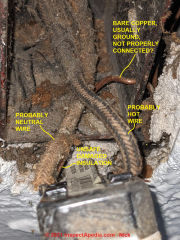 @Nick,
Apologies that I wasn't clear enough in my first try at answering.
The electrical safety with respect to the absenteeism of a grounding conductor (ground wire) in knob and tube wiring and in an insulated wire that pairs the hot and neutral wires together but still with no ground, is idential.
The electric safety of both electrical systems' wires in other regards turns on
- the condition of the wire and its insulation: if the insulation is damaged then it is less prophylactic than when new and in some positions and atmospheric condition - such as where someone could touch it and be shocked or where there could exist a fire risk - would be unsafe.
- my OPINION and that of some others in the field is that knob and tube wiring, considering the hot and neutral wires were run separately and separated by several inches, was inherently safer than wires run together in the same jacket, should both wire sets suffer equal extent of harm to their insulation.
That'south considering the K&T wires are non just so far autonomously at most locations every bit to significantly reduce the take a chance of a hot-to-neutral short, just also because even where they are supported on or pass through wood framing, the wires are carried on porcelain insulators.
Arguing with myself by adding a dose of existent-earth conditions: knob and tube, generally never declared as "illegal", may in many buildings be at greater take chances of overheating and thus risking a fire considering over the ensuing life of a edifice from its original installation - run in open air - the Chiliad&T wires may now be completely covered past added-on building insulation.
That addition violates the original design that depended on being suspended in air to handle the heat generated past use of the circuit. The result exposes the wires to overheating and damaged insulation and thus increased take a chance.
More is at KNOB & TUBE WIRING https://inspectapedia.com/electric/Knob_and_Tube_Wiring.php
Thank you for a helpful question.
Lookout out: for an inch or so (at least) back from its connection to the device the insulation is damaged and partly-lost on at to the lowest degree the neutral wire. I can't encounter the residuum of the wire's insulating jacket - bank check outside the electric box and along the wiring passage.
Watch out: we see a bare copper ground but no proper basis wire connections.
@Inspectapedia Com Moderator, Thank you for your answer! I believe it to be tinned copper wire. How much of a take a chance is the fabric jacket with the degraded rubber insulation within? Do yous believe this blazon of wire to be as much of a risk as knob and tube wiring?
@Nick,
I run into copper wire - check that it's all copper - no aluminum
No-ground: not as condom as modern - you can add together grounding
Condition: fabric itself isn't innately a defect, it's the condition of the wire that matters: cracked, damaged, missing, burned, overheated, rat-chewed insulation - needs new wiring in those cases
Watch out: One-time electrical wires using rubber insulation are often sporting cracked fragile safe that may crumble when the wire is handled. Poor-condition safe wire insulation may achieve that land from historic period solitary or from having been exposed to harsh atmospheric condition or to overheating.
I bought a house built in 1936, and the previous owner claimed the knob and tube wiring was replaced. Sadly, near l% of the wiring is every bit pictured below. Ungrounded and with textile fiber insulation. It has a black fabric jacket, with ii textile insulated wires inside and a frail rubber-like insulation confronting the copper. Information technology's everywhere in the house
. I'1000 concerned nearly the safety of this wiring and I would similar to know if this is probable from 1936. I can't see any knob and tube wiring in the basement or the attic. These wires are merely put through holes in the joists or stapled to the sides of them. I see some more than mod wire with a fabric outer jacket and mod plastic insulation, which I guess was from the 1950's or and then, merely the majority is equally pictured.
[Photo shown to a higher place at Moderator's 2nd, more-detailed reply]
@Tim,
From our research nosotros constitute that standardized electrical wire colour coding conventions entered the U.S. National Electrical Code in 1928.
Earlier that in that location were some standards such as requirements for wire insulation and wire sizes versus current or amps the wires could safely comport (without overheating to crusade a burn down) earlier, at least in New York past the NY Board of Fire Underwriters in 1881, and more national wiring standards were in place past 1893.
(The very start national electrical code in the United States, produced past the National Board of Burn down Underwriters, was completed by 1897 merely without wire color codes).
Currently the U.S. National Electric Code is sponsored by the NFPA National Fire Protection Clan - https://world wide web.nfpa.org/
When did manufacturers offset using black-and-white as a colour code for a 120 Five electric wiring
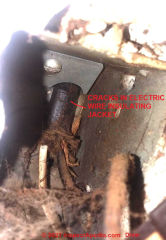 @Drew,
That looks like quite-sometime 2-conductor electric wiring, with no ground visible, just hot and neutral; its jacket or insulation looks as if it may exist bitumen-coated fabric;
Where two wires are run in a common external insulating jacket, that's not knob and tube wiring.
Simply that does Non hateful that there are no knob and tube circuits nearby in the building. And I don't run across a ground wire.
So we have two-wire (with no ground) NMC (Non-Metallic-Cable or what you meant by "Romex") entering the electrical box.
Such wire might be connected to a knob-and-tube system, or non.
Information technology would exist useful to know the location of the building, country, urban center, and the building age.
Lookout out: I encounter that the outer insulating jacket on this wire is cracked - it may exist damaged and dangerous.
Trying to effigy out if this is knob and tube or Romex
[Photo higher up]
@Wayne Riley,
On an ungrounded electrical circuit you physically tin but legally and prophylactic-wise should not install an electric receptacle that has a basis hole or opening because y'all are fooling users into thinking that the receptacle is grounded and safe for equipment that requires a ground for safe performance when in fact that's not the case.
However before deciding that y'all accept to buy a two prong united nations-Grounded receptacle to install in that location have your electrician open the electrical box and run into if a footing is present.
Often in that location is a footing present and in that case you lot can install a grounded electrical receptacle or 3-hole receptacle.
if receptacles take no ground hole, does this mean I tin can't employ a 3 hole receptacle
@Meg,
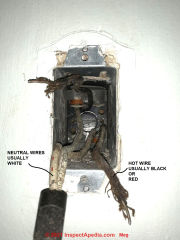 If we can pretend for a moment that the electrical wiring has been installed correctly throughout the edifice including at this electrical box,
then follow the wires dorsum into the box.
Ground Wire ID: If yous see ane of the wires connected to the metal box torso, typically by a screw or a grounding clip, that should exist a ground wire.
Usually the ground wire is bare or sports green insulation or insulation with green and yellow striping.
Hot Wire ID: Another method is to go to the electrical console and place the circuit on which this electrical box is wired.
Normally the hot or "live" wire is black, possibly red, or a combination of red and blackness.
With power off the electrician would follow the hot wire back to find the cables leaving the electric panel.
Neutral Wire ID: In the electrical panel neutral wires are connected (usually) to the neutral jitney or to a shared neutral and basis charabanc.
Commonly the neutral wire is white.
The electrician might, in the wire cable inbound the electriacl panel, find the neutral wire and follow in the panel it to its connectedness on the neutral double-decker.
There she might temporarily disconnect the neutral wire and cap it.
Now dorsum at the electrical box the ground wire will testify continuity to basis using it an ohm-meter or continuity tester, and the neutral wire should not, since it has been disconnected at its other end.
Watch out: if you're not trained and familiar with safe electric wiring, yous should know that you lot can be shocked or killed.
How do I know which wire is neutral, footing and line?
[Photo to a higher place]
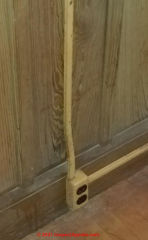 @Anonymous,
I am guessing you're asking the age of the wiring in your photograph showing surface mountain metal conduit and a unmarried surface mountain receptacle in a metal box.
It would be a kindness when you post such a question to give usa some electrical wiring age guessing Contextual Information such as
The location of the building: land and city
The age of the building
Whatsoever notes on history of electrical renovations
That said, if your building is in the U.Southward. that wiring may well have been installed
earlier 1971 - the year when the U.South. began using grounded electrical receptacles in new piece of work.
@inspectapedia.com.moderator,
[Photograph posted above without other reader comment]
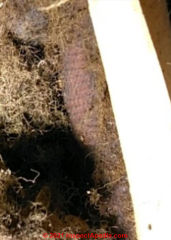 @Steven,
OK so that'southward a high-amp circuit, probably originally cloth covered, desperately frayed, and perhaps stuffing that area of the panel with electro-kindling.
As I was thinking earlier, this may exist frayed wire-loom insulation.
Run across details
at WIRE LOOM or WIREDUCT WIRE CONDUIT
On investigation y'all want to watch for a breaker that's not tripping, an overloaded circuit, rats, or mice, or overheating: something to explicate why that wire insulation is and so frayed. I suspect mice.
Looks as if some nonclerical-wiring has been done also - including leaving quite a fleck of newspaper
- more electro-kindling (a fire risk).
@inspectapedia.com.moderator, Hither is another photo.
The chocolate-brown furry wire is what I'k curious near. Here are some other photos.
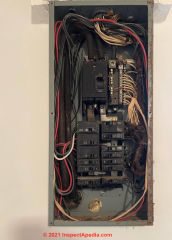
@Steven A,
I see plastic insulated or "NMC" wire and some thick light brownish fabric beneath and to the right of your spider - but I'm not sure just what material you mean.
Looks like an over-crowded electrical panel likewise.
I also see what looks similar a fabric "wire loom" type insulation in your photos - that's quite frayed.
What type of wire is this? The rough looking one?
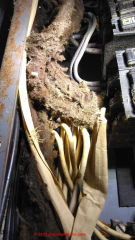
@Saul,
Your gut is on the correct digestive tract on this one in that mod do (more-recent than 1900) for electric wiring will put ceiling lighting or wall lights on a different circuit than the wall receptacles ("outlets").
That's for two reasons:
1. avoid overloading the excursion
2. increment the chances that the room doesn't remain in darkness if one circuit overloads at nighttime - e.g. if the wall receptacle circuit trips, any lamps plugged to those receptacles will go off but yous'll still have ceiling lights.
When you lot're improving the wiring it'due south good to separate those and add together circuits.
oh.....the wiring forth base of walls is encased in metal housing with periodic outlets built into it....
Older early 1900s business firm.....wiring runs along base of walls in rooms with periodic outlets.....then turns verticle to end with bulb socket.....my gut says yikes....comments welcome. Thanks
@Michael Martin,
While no one is installing solid conductor Branch wire circuits using aluminum it is still permitted and it is mutual practice to utilise multi strand aluminum wire for higher amp circuits and for the service entry cable.
I agree with you that it's not what nosotros would prefer.
It's also the instance that many electricians install that wire without using the antioxidant paste that they should exist using and they certainly don't know virtually the best practices this method of abrading the wire through the antioxidant too, as described past Aronstein at this website.
Can yous reply us more about your
dad who was on the committee to outlaw aluminum wiring.
What committee, where and when and if you have any details or documentation that would be very useful.
My dad was on the commission to outlaw aluminum wiring. I had a trailer domicile that had it and you could see outlets glowing at dark. Our house built around '68 had it. We had to pigtail copper with a liquid conductor to correct otherwise no matter how tight or skilful you made the connection it would not carry!
Then I purchase a new townhouse in '95 come to find it has aluminum wiring from the meter to my breaker box! I put usher paste at the terminals to box but don't know about meter side! But if it'southward doing what aluminum wiring normally does wouldn't that cause resistance and spiking my voltage consumption college than it really is ??!!
@anonymous,
Glad to help, and your questions aid me encounter where we demand to add details or to make information more clear.
yes, it does and thank you very much for responding to my question. also give thanks you lot for posting a photo with detailed information. and yes of course safety always number one. thank y'all !
@Anonymous,
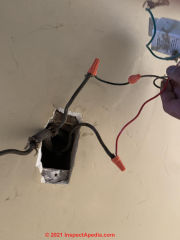 Cheers for a helpful question.
To have infinite for a detailed respond I repeat your question and respond it at
i'chiliad removing this motion sensing switch and replacing / connecting it back the regular two style light switch on my one-time house that was built around the 1920's.
how do i make up one's mind the identification of the (3) wires coming out from the wall every bit to which is the (hot) (neutral) or (ground) wiring when that are all the aforementioned color?
also on the switch i will be replacing it with the switch has more than (3) terminals to connect / replace the wires onto? how practise i know which wires go where??
@ron fancher,
Sure, that amp meter works past responding to the electrical field of generated by 60 Cycle current running through a wire. You'll run across that same method used in clamp-on amp meters they're in the hands of most electricians.
Details are at AMPS MEASUREMENT AUTOMOTIVE DC https://inspectapedia.com/electric/Amps-Measurement-DC.php
where we repeat your question and give a detailed reply;
please accept a look and let me know what questions remain.
I establish an old amp gauge on a ford tractor i am restoring, the gauge has no wires attached it just has a loop on the back that the charging wire passes thru, i would like to know more than well-nigh this design if possible, it works fine and i took it off and put it on another vehicle and it worked fine there too. thank you ron
@Drew Phillips,
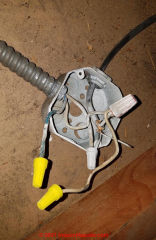 Sorry, merely no. No ane should pretend they tin can know which wires are hot, neutral, basis - for sure - from a photo.
Normally blackness (or blue, or red) would exist hot and white neutral, simply equally y'all propose, and often a pair of wires interrupts the hot to run ability through a switch for decision-making a light.
But the but safe matter to do is use a DMM or VOM to actually test each wire to be sure it's correctly used.
From the ARTICLE Index this may be of use: DMMs VOMs SAFE USE OF
and
DMM DIGITAL MULTIMETER HOW TO USE or you can use a simple neon tester to check for voltage at each wire.
I'm calculation lights to a garage ceiling in a 1960-built house. The overhead switched light is fed power by metal conduit with a blue wire and two white wires (light receptacle had blueish wire to brass connection, 1 white wire to silver connexion, no ground).
A working electrical outlet taps into this via Romex 12/3 merely the ground is left unattached and the black wire is connected to a white wire from the metal conduit source.
I initially though the bluish wire would exist hot, but peradventure the white wire connected to the Romex blackness wire is hot, which means the blue wire is neutral.
Given this set-up, can you lot confirm the hot, neutral and basis of the metal conduit power source? Not sure if this was put in when house was built or later in the 1990's. Many thanks.
@Ruby, When I notice copper wire is "stiffer" it's almost its ends where information technology's been aptitude-nearly;
Or what you take could be a hybrid like one of those unusual copper-coated steel products.
For readers who are non familiar with copper coated steel wire, it's notwithstanding made by diverse vendors. Hither's an case description:
Copper Clad Steel (CCS) is a composite usher textile containing a low carbon steel cadre surrounded by copper. The copper provides the electrical conductivity and the steel contributes force to the conductor. The most mutual class of CCS used for electrical conductors has a nominal xl% IACS electrical electrical conductivity. CCS is suitable for applications where high strength and medium conductivity are required. Copper Clad Steel is also suited for loftier frequency signal applications since loftier frequency currents travel mainly in the outer peel of a usher.
CCS is bachelor bare or plated with silver, nickel or tin.
- source: https://fiskalloy.com/
I just replaced outlets and switches in a house built in 1966. The copper wire was so much stiffer than what we apply today. Why is that? Both are size 12, copper.
@Tom D,
That could be an old, abandoned electrical service entry, though at #10 that's pretty small (30A).
Aye it's entirely possible that someone would accept buried fabric- and condom- insulated electrical wire;
When I find abandoned wires similar that, even after testing to confirm that they are not conveying current, I tie the two ends together with a connector so that should somebody somehow connect the other end to a power source the safety adventure volition be immediately apparent (as a fuse will blow).
Had some lawn piece of work done and when I was walking the expanse, I found this sticking up from the ground. This is virtually 1 pes from the street and on furthest corner of the holding (not near entryway or drive way), then I doubt information technology was for a resident installed light post or similar.
The wires are solid copper, 2 conductors, very rigid, I measured a piece and information technology'due south 10 gauge solid. The firm and area was built effectually 1938. Could this take been old electric for streetlights based upon proximity to street and the age?
Would they take used cloth wrapped wires underground and such a heavy gauge back in the twenty-four hours? Information technology was conspicuously disconnected at this end, oasis't dug it up to find other end. Have call into town to inquire them to come bank check as well.
Thanks...Tom D
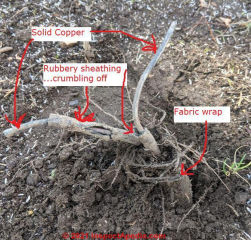
@Judy, information technology's possible merely I certainly wouldn't assume that. Instead I would have the dwelling house inspected.
I am buying a 1978 double wide will information technology have copper wiring?
...
Go along reading at OLD HOUSE Electrical WIRING or select a topic from the closely-related articles below, or run into the complete ARTICLE Index.
Or see OLD ELECTRICAL WIRING FAQs - questions and answers posted originally on this page
Or come across these
Recommended Manufactures
- AGE of a Edifice, HOW to Make up one's mind
- ALUMINUM WIRING HAZARDS & REPAIRS - dwelling
- AMPS MEASUREMENT AUTOMOTIVE DC - Sears DC Ammeter for cars, tractors, trucks, boats, motorcycles
- ASBESTOS Electric WIRE INSULATION
- Electrical COMPONENTS, Age, TYPES
- Electric GROUNDING in OLDER HOMES
- ELECTRICAL Panel Age
- ELECTRICAL WIRE TYPES CODES USES
- OLD HOUSE Electric SYSTEMS
- Antique & Old ELECTRICAL RECEPTACLES
- ANTIQUE LAMPS (BULBS) & CONNECTOR TYPES
- ANTIQUE LAMPS (BULBS) LIGHT OUTPUT - LUMENS
- BULB & LAMP TYPES GUIDE - domicile
- GROUNDING, OLD House ELECTRICAL
- VOLTAGE Available in OLDER HOMES
- AMPACITY AVAILABLE in OLDER HOMES
- KNOB & TUBE WIRING
- NUMBER of CIRCUITS in Sometime BUILDINGS
- ELECTRICAL Brusk CIRCUITS
- POLARIZED PLUGS, RECEPTACLES, LIGHTS
- OLD ELECTRICAL WIRING TYPES
- SOLID PIPE EDISON DC CABLE HISTORY
Suggested citation for this web page
OLD Electric WIRING TYPES at AuditApedia.com - online encyclopedia of building & ecology inspection, testing, diagnosis, repair, & problem prevention advice.
Or see this
Alphabetize to RELATED ARTICLES: Commodity INDEX to ELECTRICAL INSPECTION & TESTING
Or utilize the SEARCH BOX found below to Enquire a Question or Search InspectApedia
...
Ask a Question or Search InspectApedia
Try the search box only below, or if yous adopt, postal service a question or comment in the Comments box beneath and we volition respond promptly.
Search the InspectApedia website
Note: appearance of your Comment below may be delayed: if your annotate contains an image, web link, or text that looks to the software as if information technology might exist a web link, your posting will announced after it has been approved by a moderator. Apologies for the delay.
Technical Reviewers & References
Click to Evidence or Hide Citations & References
Publisher InspectApedia.com - Daniel Friedman

Source: https://inspectapedia.com/electric/Old_Electrical_Wiring.php
Posted by: monteithlentep.blogspot.com
0 Response to "How To Wire A 20 Year Old Night Vision Two Wire Camera"
Post a Comment